
Race Informantion, Rules,
Terms & Conditions and
Child Protection Policy
August 2016
Please check this page from time to time for updates.
By completing an entry form to a Laser Biathlon GB event you confirm that:
- you agree to these Rules, Terms & Conditions and Child Protection Policy.
- you do not have any criminal convictions that would mean you are unsuitable to compete alongside and camp at weekend events with children and young people under 18 years of age.
- you give consent for Laser Biathlon GB to request information on you from the Criminal Records Bureau should the need arise.
- if you are a parent or guardian of a child or young person under the age of 18, in your absence, you consent to Laser Biathlon GB staff or volunteers treating your child for first aid or taking other actions deemed necessary in the event of an emergency or to protect your child.
Handling of biathlon rifle
The rifle must be treated as if it were a 'loaded' rifle. We do not want to alarm the general public who may be unaware laser rifles are being used.
The laser rifles are 100% safe – they use Class 2 laser technology (which is used in presentation pointer pens and supermarket checkouts). A person receiving an eye exposure from a Class 2 laser beam, either accidentally or as a result of someone else’s deliberate action (misuse) will be protected from injury by their own natural aversion response. This is a natural involuntary response which causes the individual to blink and avert their head thereby terminating the eye exposure.
The rifle contains expensive laser electronics and sights which are both fragile and must be treated with respect. The rifles are for everyones use, please handle with care to ensure the next person to enter the range does not suffer from your misuse.
Misuse of rifles resulting in damage will result in disqualification and bill for repair.
Rules for the target range:
- Wait outside the range until a Range Marshal directs you to a rifle and obey any instructions.
- Do not remove the rifle from the target range (supervised area).
- Do not point the rifle at anyone (only point the rifle at the targets).
- Point the rifle at the ground until ready to shoot.
- Following your shoot, do not drop the rifle, or throw it to the ground. Replace the rifle on the mat pointing towards the target.
- Do not hand the rifle to the next competitor (it may be sporting but this is bad gun practice).
- Do not shout or do anything to distract another competitor in the range.
- When entering the range do so from the back. Do not enter from the side stepping over competitors already in the range.
- Disregard of any of the above will result in immediate disquallification.
Targets and penalty loops
You will have 5 shots to hit 5 targets. If you miss a target you will have to run a small penalty loop (of about 20 seconds) for each target missed before you head out on to your next lap.
If there is not enough space for a penalty loop, you will incur a 20 second penalty for each target missed (added to your time at the end of the race).
General
- Your payment receipt (via email) is confirmation of your entry. No details are sent out via post.
- Before you set-off from home for the event you should check for updates. These appear on the Twitter page https://twitter.com/laserbiathlon and website (in the 'Tweets' panel on the left under the menu).
- Directions for each event are published on the website; click RACES/DATES in the menu then on the event in the calendar. Click on MAP to view the location of the event; MORE INFO will give any specific venue information. Signs will be positioned at the venue to direct you to the event.
- The parking, race office, info board, registration, bib collection and start/finish lines are normally close to each other.
- Please park sensibly and considerately to other park users. Do not block access roads or park in front of gates as these need to be kept clear for emergency vehicles. If there is a parking charge, please pay. If there is a parking marshal, please park where directed.
- Please note there is NO baggage or key drop off provision.
Laser Biathlon GB cannot be held liable for any accident, injury, damage or loss to you, anyone accompanying you or your equipment.
It is advised that you should be checked out by a doctor before running. The organisers are not held responsible for any accident or injury sustained during the race. If in doubt, do not run.
Registration, bib collection, information
You can self register and collect your bib using the following instructions. A list of competitors can be found on the info board at the event on the event trailer.
- Find your name, bib number, and class.
- Check you are entered into the correct class.
- Take your bib from the blue folder. Double check you have the correct bib (this is unique to you). If your bib is not in the folder we need to see you – please see a Race Marshal.
- Pin your bib to the front of your chest so it is clearly visible to all especially start/finish timers and marshals – if marshals can’t see your bib you won’t be timed. Please pin in the location marked on the bib to make it easier for marshals to punch your bib for targets hit and penalty loops. Please do not cut or fold your bib. Don’t forget to bring safety pins – if you borrow pins, please return after the race.
- There will be someone to help and answer any questions before the race starts.
A course map can be found on the info board.
Course signage
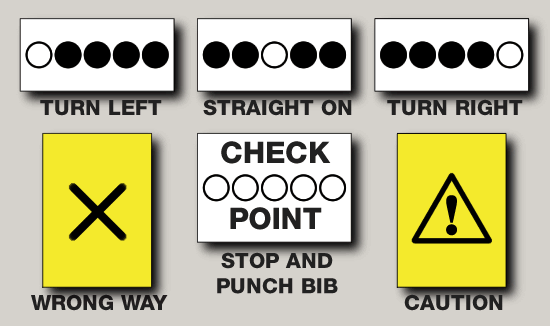
The signs above will mark the course, we do not use arrows as they can be 'played with'. The 'Straight on' sign can be vertical or horizontal and confirm you are on the right track.
Check Point sign:
If you see a 'Check Point' sign you must stop and punch your race bib using the punch tied to the tree alongside the sign. You must do this once for each lap (ie do not punch your bib 3 times on the first lap). This will be checked each time you enter the target range and at the finish.
Be aware of the yellow signs, these tell you:
- if you are going the 'Wrong Way' (normally where there are many tracks crossing or the possibility of missing a truning sign and heading straight-on on the wrong track).
- to proceed with 'Caution'; steep, slippery or rough trail conditions, crossing other trails (MTB), areas where you may encounter the public.
The race
- The start and finish shoots will be lined with banners.
- Starts can be either:
- mass starts in class groups (most venues), or
- individual starts (assigned randomly by computer in class order)
with short intervals (depending on space available and safety)
- When you see a 'CHECK POINT' sign you must stop and punch your bib. You must do this once on each lap. NB If you do not punch your bib you will not be able to enter the target range.
- You have 5 shots to hit 5 targets.
- For each target you miss you must do a small penalty loop (ie 5 misses = 5 penalty loops). You will be given a wrist band for each target you miss (ie 5 misses = 5 wrist bands).
- Each time you complete a penalty loop you must give a wrist band to the penalty loop marshal.
- The above must be repeated for your second lap.
- You only visit the target range after the first two laps, after the third lap you cross the finish line.
- When you cross the finish line, please ensure the finish timer and spotter can see your bib – if not, your time may not be recorded.
- You must not impede the progress of another competitor at any time.
- Competitors must not verbally, or physically, abuse any member of the public, fellow competitor or marshal at any point, before, during or after the race.
- Under 17s may be accompanied by an adult if deemed necessary by the parent/guardian.
Penalties
Penalties are issued at the discretion of the Race Marshals, depending on the circumstances of the incident.
The following may take place at Race Marshals discretion:
ADVICE
WARNING (when advice has been ignored and a further race incident occurs)
TIME PENALTY (minimum 30 seconds and thereafter 30 second increments)
DISQUALIFIED (no time recorded for race)
DISQUALIFIED (for 2 or more races)
BAN (all Race Marshals to be involved regarding the implementation of a ban)
Age
groups and distances (human)
Terrain
Closing date and Pay-on-the-day
Bad weather, cancellation, refunds and credits
Fitness and First Aid
Event photography
Your responsibilities
The course
Camping (selected venues only)
Child Protection Policy
Classes, distances and age groups
| Classes | |||
| Class | Distance (*) | Codes | Age range |
| Adult (4x prone shoots) | |||
| Male | +/–1km x5 | M | 17+ |
| Female | +/–1km x5 | F | 17+ |
| Under 17s (2x prone shoots) | |||
| Juniors | +/–1km x3 | J (M+F combined) | Under 17 |
| Adult short course (2x prone shoots) | |||
| Male/Female | +/–1km x3 | S (M+F combined) | 17+ |
| (*) Distance may not be exact due to the nature of forest trails. | |||
| NB Classes may be combined if numbers dictate | |||
Competitors aged under 17 please note:
- We advise that an adult accompany children under 17 on the course, for safety reasons, in case a child is approached by a member of the public, gets lost, or injured. At times your child will be alone in the forest out of sight of a marshal.
- Under 17s: run with parental/guardian consent.
- Please refer to our Child Protection Policy.
Terrain
Events are run on cross-country trails. Hazards may include wet slippery surfaces including downhills, grass,
mud, snow/ice, twigs/branches from tree fall, loose stones and gullies formed by water erosion – all of which may be hidden under thick blanket of leaves. Please be prepared for all of the above terrain.
Closing date
Laser Biathlon GB may close the entry prior to the
advertised closing date if entry capacity is reached. If capacity is not
reached, entries will remain open until 23:59 the Monday prior the
event (unless specified). We do not take entries on the day of the race.
Bad weather, cancellation, refunds and credit
All competitors should check our Twitter page for updates before setting off for the event. This will not only inform you the event is proceding as planned, but give you any new information we have right up until the morning of the race. We use Twitter to spread this information as it can be sent via text message from a mobile phone - forests generally have bad mobile signals and we cannot access the internet to send emails. Twitter will also send you a text the second we issue an update (if you choose this in your Twitter settings). if you do not have a Twitter account, these updates also appear on every page of our website in the 'Tweets' panel on the left.
From the moment an event goes into planning, costs start to be incured. Your entry fee is invested into the cost of staging the event - everything from barriers to signage, printing to safety pins, race numbers to marketing, land owner permissions/costs, public liability insurance, risk assessments and first aid cover not to mention time and admin 24/7. Organising any event requires a considerable amount of forward planning, risk and expense. The cancellation policy reflects this and is as follows:
| Cancellation Policy | |
| Competitors withdrawing from event A credit will be issued as follows: |
|
| Notification dated 8 weeks (57 days) or more before the event | 50% credit |
| Notification dated 4 to 8 weeks (29 to 56 days) before the event | 20% credit |
| Notification dated less than 4 weeks (28 days) before the event | No credit |
| Notify Laser Biathlon GB in writing via email info@laserbiathlon.co.uk giving your full name and event you are withdrawing from. Date of withdrawal is the date of email. Telephone messages are not acceptable. Race entries are NOT transferable to any other person or any other event. The online entry system and race database is fully automated and any manual changes to the data held on the race database requires considerable time and cost in administration. |
|
| Event cancelled due to reasons beyond organisers control | |
| if an event is cancelled due to reasons beyond the organisers control, we regret that no entry fees can be refunded, credited or deferred to future events. This is due to the amount of admin, organisation and cost that goes into each event prior to the actual event itself. We have organised over 250 cross-country running events in the past 10 years and have only had to cancel two events due the venue being closed as a result of bad weather. |
|
| Event cancelled by organiser | |
| if an event is cancelled by the organiser for reasons within it's control, a full refund will be issued. | |
Distance Selling Regulations
Merchandise orders are governed by the Distance Selling Regulations which allow every customer the right to cancel their merchandise order within 7 working days of placing the order. This cancellation right does not extend to race entries or membership.
Prizegiving
There is no prizegiving. Results will be posted HERE following the event.
Fitness and First Aid
In all cases the safety and health of you is paramount. If you are not active, it is advised that you should be checked
out by your doctor before running. The organisers are not held
responsible for any accident or injury sustained during the race. If in
doubt, do not run.
Qualified First Aiders will be available on the day – ask a Race Marshal.
Event Photography
By entering and taking part in the event, you automatically consent (model release) to photographs of you being used in any promotion by Laser Biathlon GB and offered for resale. Any photograph taken by anyone at a Laser Biathlon GB event is the intellectual property of Laser Biathlon GB protected by a registered trademark. Any photographer offering photos of a Laser Biathlon GB event for purchase, OR FOR FREE (in both physical and digital formats) must have permission from Laser Biathlon GB in writing beforehand.
Photographs purchased of a Laser Biathlon GB event are for personal use only, and cannot be resold or offered for use for free (in whole, or part, or any manipulated version) or used for commercial purposes without the prior written permission from Laser Biathlon GB and the photographer for the use in question. Each subsequent use will require a new permission to be granted. The copyright ownership of all photos remains with the photographer. The purchase of a photo does not assign or transfer copyright ownership to the purchaser.
- Racing bibs supplied by Laser Biathlon GB must be worn on the front of your garment attached with 4x safety pins in each corner (please supply your own pins). The whole bib must be visible at all times during the race. If your bib is not visible to the start timer you will be asked to leave the start line, rectify the problem and be moved to the end of the queue to restart. The whole bib must be visible to the finish timers, marshals, the public and other runners throughout the race - failure to do so may result in your time not being recorded. Bibs must not be altered or defaced in any way or the sponsors logos/Laser Biathlon GB logo intentionally obscured. Sponsors use the bibs to promote their companies and sponsor logos are to be on display at all times - failure to do so may result in the removal of sponsorship resulting in increased entry fees and jeopardise the future of Laser Biathlon GB events.
- Unsportsmanlike, aggressive, threatening, abusive or any behaviour deemed to be unacceptable at any stage during the event will not be tolerated. As well as the distress negative behaviour causes, Laser Biathlon GB events are attended by families with young children. The venues are public places where families come to enjoy themselves. This also extends to intimidation or harassment of runners, marshals, helpers, volunteers or Laser Biathlon GB outside of events.
Laser Biathlon GB have a permit to operate in the various venues and in the course of running the events have permission to promote, sell or endorse Laser Biathlon GB.
Laser Biathlon GB respectfully request that you do not bring flyers, brochures or display any placards, bills, cards or notices. Television crews, photographers, live radio, press and freelance journalists are invited by Laser Biathlon GB to promote Laser Biathlon GB. Any person undertaking any of these activities without an invitation will be in breach of venue byelaws and rules & regulations.
- Runners start at either timed intervals
or mass starts (if space is available). The winner will be the one to complete the course in the fastest
time.
- Markers will be placed at regular intervals
to indicate the direction of the course.
- Marshals and/or checkpoints will be positioned
along the course. You may need to punch your racecard at certain checkpoints.
- Any form of abuse of marshals will result in automatic disqualification and possible ban from future events.
Camping (selected venues
only)
Camping is at your own risk. You are responsible
for the health, welfare and actions of your party.
Neither land owners or Laser Biathlon GB accept responsibility for damages or loss including accident or injury resulting from the use of the camping facilities.
Anybody whose behaviour is considered unacceptable will be asked to leave.
Disregard of any of the above may result in a ban from future events. Refunds will not be issued if your actions result in any of the above.
Laser Biathlon GB reserve the right to amend these rules if circumstances dictate and apply retrospectivly should the need arise. Event entries may be declined at the organisers discretion.
Laser Biathlon GB Child Protection Policy
Introduction
All sporting organisations which make provision for children and young people must ensure that:
- the welfare of the child is paramount.
- all children, whatever their age, culture, disability, gender, language, racial origin religious beliefs and/or sexual identity have the right to protection from abuse.
- all suspicions and allegations of abuse and poor practice will be taken seriously and responded to swiftly and appropriately.
- all staff (paid/unpaid) working in sport have a responsibility to report concerns to the appropriate officer.
Staff/volunteers are not trained to deal with situations of abuse or to decide if abuse has occurred.
Policy statement/aims
Laser Biathlon GB has a duty of care to safeguard all children involved in Laser Biathlon GB from harm. All children have a right to protection, and the needs of disabled children and others who may be particularly vulnerable must be taken into account. Laser Biathlon GB will ensure the safety and protection of all children involved in Laser Biathlon GB through adherence to the Child Protection guidelines adopted by Laser Biathlon GB.
A child is defined as a person under the age of 18 (The Children Act 1989).
Policy aims
The aim of the Laser Biathlon GB Child Protection Policy is to promote good practice:
- providing children and young people with appropriate safety and protection whilst in the care of Laser Biathlon GB.
- allow all staff /volunteers to make informed and confident responses to specific child protection issues.
Promoting good practice
Child abuse, particularly sexual abuse, can arouse strong emotions in those facing such a situation. It is important to understand these feelings and not allow them to interfere with your judgement about the appropriate action to take.
Abuse can occur within many situations including the home, school and the sporting environment. Some individuals will actively seek employment or voluntary work with young people in order to harm them. A coach, instructor, teacher, official or volunteer will have regular contact with young people and be an important link in identifying cases where they need protection. All suspicious cases of poor practice should be reported following the guidelines in this document.
When a child enters a sporting activity having been subjected to child abuse outside the sporting environment, sport can play a crucial role in improving the child’s self-esteem. In such instances the organisers must work with the appropriate agencies to ensure the child receives the required support.
Good practice guidelines
All personnel should be encouraged to demonstrate exemplary behaviour in order to promote childrens welfare and reduce the likelihood of allegations being made. The following are common sense examples of how to create a positive culture and climate.
Good practice means:
- Always working in an open environment (e.g. avoiding private or unobserved situations and encouraging open communication with no secrets).
- Treating all young people/disabled adults equally, and with respect and dignity.
- Always putting the welfare of each young person first, before winning or achieving goals.
- Maintaining a safe and appropriate distance with runners (e.g. it is not appropriate for staff or volunteers to have an intimate relationship with a child or to share a room with them).
- Building balanced relationships based on mutual trust which empowers children to share in the decision-making process.
- Making sport fun, enjoyable and promoting fair play.
- Ensuring that if any form of manual/physical support is required, it should be provided openly. Care is needed, as it is difficult to maintain hand positions when the child is constantly moving. Young people and their parents should always be consulted and their agreement gained.
- Keeping up to date with technical skills, qualifications and insurance in sport.
- Involving parents/carers wherever possible. For example, encouraging them to take responsibility for their children in the changing rooms. If groups have to be supervised in the changing rooms, always ensure parents, teachers, coaches or officials work in pairs.
- Ensuring that if mixed teams are taken away, they should always be accompanied by a male and female member of staff. However, remember that same gender abuse can also occur.
- Ensuring that at tournaments or residential events, adults should not enter children’s rooms or invite children into their rooms.
- Being an excellent role model - this includes not smoking or drinking alcohol in the company of young people.
- Giving enthusiastic and constructive feedback rather than negative criticism.
- Recognising the developmental needs and capacity of young people and disabled adults - avoiding excessive training or competition and not pushing them against their will.
- Securing parental consent in writing to act in loco parentis, if the need arises to administer emergency first aid and/or other medical treatment.
- Keeping a written record of any injury that occurs, along with the details of any treatment given.
- Requesting written parental consent if Laser Biathlon GB officials are required to transport young people in their cars.
Practices to be avoided
The following should be avoided except in emergencies. If cases arise where these situations are unavoidable it should be with the full knowledge and consent of someone in charge or the child’s parents. For example, a child sustains an injury and needs to go to hospital, or a parent fails to arrive to pick a child up at the end of a session:
- avoid spending time alone with children away from others.
- avoid taking or dropping off a child to an event or activity.
Practices never to be sanctioned
The following should never be sanctioned. You should never:
- engage in rough, physical or sexually provocative games, including horseplay.
- share a room with a child.
- allow or engage in any form of inappropriate touching.
- allow children to use inappropriate language unchallenged.
- make sexually suggestive comments to a child, even in fun.
- reduce a child to tears as a form of control.
- fail to act upon and record any allegations made by a child.
- do things of a personal nature for children or disabled adults, that they can do for themselves.
- invite or allow children to stay with you at your home/van/caravan/tent unsupervised.
NB It may sometimes be necessary for staff or volunteers to do things of a personal nature for children, particularly if they are young or are disabled. These tasks should only be carried out with the full understanding and consent of parents and the runners involved. There is a need to be responsive to a person’s reactions. If a person is fully dependent on you, talk with him/her about what you are doing and give choices where possible. This is particularly so if you are involved in any dressing or undressing of outer clothing, or where there is physical contact, lifting or assisting a child to carry out particular activities. Avoid taking on the responsibility for tasks for which you are not appropriately trained.
Incidents that must be reported/recorded
If any of the following occur you should report this immediately to the appropriate officer and record the incident. You should also ensure the parents of the child are informed:
- if you accidentally hurt a runner.
- if he/she seems distressed in any manner.
- if a runner appears to be sexually aroused by your actions.
- if a runner misunderstands or misinterprets something you have done.
Use of photographic/filming equipment at sporting events
There is evidence that some people have used sporting events as an opportunity to take inappropriate photographs or film footage of young and disabled sportspeople in vulnerable positions. Any concerns should to be reported to Laser Biathlon GB.
Videoing as a coaching aid: there is no intention to prevent the use of video equipment as a legitimate coaching aid. However, runners and their parents/carers should be made aware that this is part of the programme and their consent obtained, and such films should be stored safely.
Recruitment and training of staff and volunteers
Laser Biathlon GB recognises that anyone may have the potential to abuse children in some way and that all reasonable steps are taken to ensure unsuitable people are prevented from working with children. Preselection checks must included the following:
- All volunteers/staff should complete an application form. The application form will elicit information about an applicant's past and a self disclosure about any criminal record.
- Consent should be obtained from an applicant to seek information from the Criminal Records Bureau.
- Evidence of identity (passport or driving licence with photo).
Interview and induction
All employees (and volunteers) will be required to undergo an interview carried out to acceptable protocol and recommendations. All employees and volunteers should receive an induction, during which:
- A check should be made that the application form has been completed in full (including sections on criminal records and self-disclosures).
- Their qualifications should be substantiated.
- The job requirements and responsibilities should be clarified.
- Child protection procedures are explained and training needs are identified.
- They should sign up to the organisation’s Code of Ethics and Conduct and Child Protection policy.
Training
In addition to preselection checks, the safeguarding process includes training after recruitment to help staff and volunteers to:
- Analyse their own practice against established good practice, and to ensure their practice is not likely to result in allegations being made.
- Recognise their responsibilities and report any concerns about suspected poor practice or possible abuse.
- Respond to concerns expressed by a child or young person.
- Work safely effectively with children.
Laser Biathlon GB requires:
- Relevant personnel to receive advisory information outlining good practice and informing them about what to do if they have concerns about the behaviour of an adult towards a young person.
- Relevant personnel to gain a national first aid training (where necessary).
- Attend update training when necessary. Information about meeting training needs can be obtained from Sports Coach UK, the NSPCC, and the Sport Council.
Responding to allegations or suspicions
It is not the responsibility of anyone working in Laser Biathlon GB, in a paid or unpaid capacity to decide whether or not child abuse has taken place. However there is a responsibility to act on any concerns by reporting these to the appropriate officer or the appropriate authorities.
Laser Biathlon GB will assure all staff/volunteers that it will fully support and protect anyone, who in good faith reports his or her concern that a colleague is, or may be, abusing a child.
Where there is a complaint against a member of staff there may be three types of investigation:
- a criminal investigation
- a child protection investigation
- a disciplinary or misconduct investigation.
The results of the police and child protection investigation may well influence and inform the disciplinary investigation, but all available information will be used to reach a decision.
Reporting concerns about poor practice
If, following consideration, the allegation is clearly about poor practice the designated Laser Biathlon GB Child Protection Officer will deal with it as a misconduct issue.
If the allegation is about poor practice by the Laser Biathlon GB Child Protection Officer, or if the matter has been handled inadequately and concerns remain, it should be reported to the Laser Biathlon GB Race Referees who will decide how to deal with the allegation and whether or not to initiate disciplinary proceedings.
Reporting concerns about suspected abuse
Any suspicion that a child has been abused by either a member of staff or a volunteer should be reported to the Laser Biathlon GB Child Protection Officer, who will take such steps as considered necessary to ensure the safety of the child in question and any other child who may be at risk.
The Laser Biathlon GB Child Protection Officer will refer the allegation to the social services department who may involve the police.
The parents or carers of the child will be contacted as soon as possible following advice from the social services department.
If the Laser Biathlon GB Child Protection Officer is the subject of the suspicion/allegation, the report must be made to the Laser Biathlon GB Race Referees who will refer the allegation to Social Services.
If you are concerned about a child and unable to contact the designated person, please call the NSPCC 24-hour Helpline on 0808 800 5000.
Confidentiality
Every effort should be made to ensure that confidentiality is maintained for all concerned. Information should be handled and disseminated on a need to know basis only. This includes the following people:
- the Laser Biathlon GB Child Protection Officer.
- the parents of the person who is alleged to have been abused.
- the person making the allegation.
- social services/police.
- the Laser Biathlon GB Race Referees.
Seek social services advice on who should approach the alleged abuser (or parents if the alleged abuser is a child).
Information should be stored in a secure place with limited access to designated people, in line with data protection laws (e.g. that information is accurate, regularly updated, relevant and secure).
Enquiries and further action
Internal enquiries and possible suspension
The Laser Biathlon GB Child Protection Officer will make an immediate decision about whether any individual accused of abuse should be temporarily suspended pending further police and social services inquiries.
Irrespective of the findings of the social services or police inquiries the Laser Biathlon GB Race Referees will assess all individual cases to decide whether a member of staff or volunteer can be reinstated and how this can be sensitively handled.
This may be a difficult decision; particularly where there is insufficient evidence to uphold any action by the police. In such cases, the Laser Biathlon GB Race Referees must reach a decision based upon the available information which could suggest that on a balance of probability, it is more likely than not that the allegation is true. The welfare of the child should remain of paramount importance throughout.
Support to deal with the aftermath of abuse
Consideration should be given to the kind of support that children, parents and members of staff may need. Use of helplines, support groups and open meetings will maintain an open culture and help the healing process.
The British Association for Counselling Directory is available from The British Association for Counselling, 1 Regent Place, Rugby CV21 2PJ, Tel: 01788 550899, Fax: 01788 562189, E-mail: bac@bacp.co.uk, Internet: www.bacp.co.uk .
Consideration should be given to what kind of support may be appropriate for the alleged perpetrator.
Allegations of previous abuse
Allegations of abuse may be made some time after the event (e.g. by an adult who was abused as a child or by a member of staff who is still currently working with children).
Where such an allegation is made, Laser Biathlon GB will follow the procedures as detailed above and report the matter to the social services or the police. This is because other children, either within or outside sport, may be at risk from this person. Anyone who has a previous criminal conviction for offences related to abuse is automatically excluded from working with children. This is reinforced by the details of the Protection of Children Act 1999.
Bullying
If bullying is suspected, the same procedure should be followed as set out in 'Responding to suspicions or allegations' above.
Action to help the victim and prevent bullying in sport:
- Take all signs of bullying very seriously.
- Encourage all children to speak and share their concerns (It is believed that up to 12 children per year commit suicide as a result of bullying, so if anyone talks about or threatens suicide, seek professional help immediately). Help the victim to speak out and tell the person in charge or someone in authority. Create an open environment.
- Investigate all allegations and take action to ensure the victim is safe. Speak with the victim and the bully(ies) separately.
- Reassure the victim that you can be trusted and will help them, although you cannot promise to tell no one else.
- Keep records of what is said (what happened, by whom, when).
- Report any concerns to the Laser Biathlon GB Child Protection Officer or the school (wherever the bullying is occurring).
Action towards the bully(ies):
- Talk with the bully(ies), explain the situation, and try to get the bully(ies) to understand the consequences of their behaviour. Seek an apology to the victim(s).
- Inform the bully’s parents.
- Insist on the return of 'borrowed' items and that the bully(ies) compensate the victim.
- Provide support for the victim's coach.
- Impose sanctions as necessary.
- Encourage and support the bully(ies) to change behaviour.
- Hold meetings with the families to report on progress.
- Inform all organisation members of action taken.
- Keep a written record of action taken.
- Most 'low level' incidents will be dealt with at the time by coaches and volunteers. However, if the bullying is severe (e.g. a serious assault), or if it persists despite efforts to deal with it, incidents should be referred to the designated Laser Biathlon GB Child Protection Officer as in "responding to suspicions or allegations" above.
Reporting concerns outside the immediate sporting environment (e.g. a parent or carer)
Report your concerns to the Laser Biathlon GB Child Protection Officer, who should contact social services or the police as soon as possible.
If the Laser Biathlon GB Child Protection Officer is not available, the person being told of or discovering the abuse should contact social services or the police immediately.
Social Services and the Laser Biathlon GB Child Protection Officer will decide how to involve the parents/carers.
The Laser Biathlon GB Child Protection Officer should also report the incident to the Laser Biathlon GB Race Referees. The Laser Biathlon GB Race Referees should ascertain whether or not the person/s involved in the incident play a role in Laser Biathlon GB and act accordingly.
Maintain confidentiality on a need to know basis only.
Providing information to police or social services
Information about suspected abuse must be accurate and a detailed record should always be made at the time of the disclosure/concern. It should include the following:
- The child's name, age and date of birth of the child.
- The child's home address and telephone number.
- Whether or not the person making the report is expressing their own concerns or those of someone else.
- The nature of the allegation. Include dates, times, any special factors and other relevant information.
- Make a clear distinction between what is fact, opinion or hearsay.
- A description of any visible bruising or other injuries. Also any indirect signs, such as behavioural changes.
- Details of witnesses to the incidents.
- The child’s account, if it can be given, of what has happened and how any bruising or other injuries occurred.
- Have the parents been contacted?
- If so what has been said?
- Has anyone else been consulted? If so record details.
- If the child was not the person who reported the incident, has the child been spoken to? If so what was said?
- Has anyone been alleged to be the abuser? Record details.
- Where possible referral to the police or social services should be confirmed in writing within 24 hours and the name of the contact who took the referral should be recorded.
If you have any concerns about a child call the NSPCC 24-hour Helpline on 0808 800 5000 for immediate advice
Help for children and young people
- ChildLine: 0800 1111
Help for adults concerned about a child
- 0808 800 5000